Troubleshooting Geothermal Loop System Efficiency Loss
Your system’s still running. The house is still cooling. But the bills keep creeping up, and the unit seems to run a lot longer than it did a few years ago. That’s the quiet warning sign most Plano homeowners miss a geothermal loop that’s losing ground without ever fully quitting on you.
Low Flow Is the First Place to Look
The geothermal loop does one job: move heat between your home and the earth. If fluid isn’t circulating at the right rate, that heat exchange slows down and the whole system has to work harder to hit your setpoint.
I’ve seen this go wrong when a circulation pump starts drawing too much current but nobody catches it until the electric bill shows up. Air locked in the loop does the same thing, killing the flow rate without any obvious noise or fault code. Checking the pressure drop across the loop tells you fast whether flow is the culprit. If you’ve got an older system with a single-speed pump, that pump is also the first component I’d suspect after about 15 years of continuous service.
Ground Temperature Recovery
Here’s something that catches homeowners off guard: the earth around your geothermal loop can actually become thermally saturated if the loop field was undersized at install or if the system’s been running hard through back-to-back brutal North Texas summers.
When the ground can’t shed heat fast enough between cycles, the entering fluid temperature climbs, and efficiency drops. I’ve pulled entering water temps on systems in West Plano that were running 10–12°F hotter than they should be mid-July, and in every case, the loop field was shorter than what current design standards call for. This doesn’t always have a cheap fix, but knowing it’s the problem is better than chasing phantom refrigerant leaks for two years.
Fluid Condition and Loop Integrity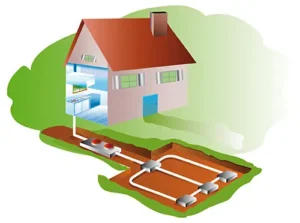
The antifreeze mixture inside a closed geothermal loop isn’t something most people think about. It should be. Low concentration means a freeze risk in winter. High concentration hurts heat transfer. And if the pH drifts, you get corrosion products building up inside the piping and heat exchanger which is essentially rust-colored insulation you didn’t ask for.
A leak is the other honest concern. Loop piping is tough, and a properly installed system can last the longest of any component in your house 50 years or more is realistic. But ground movement, improper fittings at install, or a previous repair done without proper fusion equipment can all introduce slow seepage. We pressure-test loops every time we service a geothermal system in Plano, because a 5 psi drop over 30 minutes tells you something that no amount of visual inspection ever could.
Heat Exchanger Fouling and Aging Equipment
Plano sits on the edge of the Blackland Prairie, and the groundwater chemistry here leans hard toward mineral content. If you’ve got an open-loop or pond system, scale buildup on the heat exchanger is almost a given after several years without a cleaning. Even closed-loop systems accumulate debris at strainers and develop fouling inside the refrigerant-to-water heat exchanger over time.
Worn components compound the problem. A failing TXV, degraded capacitors, or a compressor running outside its pressure envelope can each quietly drag efficiency down before anything codes out. Annual maintenance catches most of this. Skipping it for three or four years is when small issues stack up into a repair bill nobody wanted.
Call Total Air and Heat Before a Small Problem Gets Expensive
Your trusted next-door neighbor for 65 years, Total Air and Heat serves Plano homeowners who know what it costs to let a geothermal issue run too long. A circulation pump that’s struggling today can take out a compressor by next summer and that’s the repair nobody budgets for.
If your system’s running longer, costing more, or just feels off, give us a call. Diagnostics on a geothermal loop usually take 45 minutes to two hours, and you’ll leave with real answers.
Frequently Asked Questions
How long does a geothermal loop last?
The loop field itself the buried piping routinely lasts 50 years or more when it was installed with proper fusion fittings and the right fluid chemistry maintained. Indoor equipment has a shorter lifespan, usually 20–25 years for the heat pump. The loop is almost never the first thing that fails.
Can I check geothermal loop performance myself?
You can check filter condition, thermostat settings, and whether the unit is short-cycling. Anything involving loop pressure, fluid concentration, or entering/leaving water temps requires a manifold and calibrated gauges not a DIY job, and not something a standard HVAC tech is always equipped for either.
Why are my bills higher if the system still seems to work?
Efficiency loss is gradual. The geothermal loop can transfer heat less effectively for months before comfort noticeably drops, but your electricity meter catches it immediately. Flow restrictions, fouled heat exchangers, and low refrigerant charge all push up runtime without triggering fault codes.
Does North Texas weather affect geothermal performance?
More than people expect. Extended heat waves which Plano sees most summers stress undersized loop fields. We also get occasional hard freezes that matter if your antifreeze concentration has drifted low. Both are real risks that a yearly check-in prevents.
How often should a geothermal system be serviced?
Once a year, minimum. Most manufacturers require annual maintenance to keep warranties intact, and in Texas’s climate, skipping even one season creates risk. A good tuneup covers loop pressure, fluid quality, heat exchanger condition, electrical checks, and system performance data not just a filter swap.
Call us when you’re ready. We’ll find it.