What Does It Mean If My AC Is Making Loud  Noises?
Air conditioners hum. They whoosh. They click once when the compressor kicks on. None of that is unusual. But when a unit starts making loud noises that pull your attention from across the house, that’s a different conversation.
The tricky part is that not every loud noise means the same thing. Some point to minor issues. Some point to something that’ll cost you a compressor if you let it run another 48 hours. Knowing the difference starts with the sound itself.
What the Sound Is Telling You
Banging or Clanking
This is the one that should get you moving fast. Banging almost always means something has come loose inside the outdoor unit a fan blade, a motor mount, or an internal compressor component. When those parts start moving where they shouldn’t, each rotation makes it worse.
A fan blade that’s partially detached will sound like someone hitting sheet metal with a hammer. It’s not subtle. If that’s what you’re hearing, turn the system off. Don’t wait to see if it settles down.
Screeching or Squealing
High-pitched loud noises from an AC usually trace back to a motor bearing either in the blower motor or the condenser fan motor. Older systems with belt-driven components can produce this sound from a worn belt, though that’s less common in modern equipment.
The frustrating thing about squealing is that it tends to come and go at first, which gives people a reason to ignore it. It won’t resolve on its own. Once a bearing starts going, it’s on its way out.
Clicking That Keeps Going
A single click at startup is normal, that’s the contactor engaging. Repeated clicking, where the system just keeps trying and trying, is an electrical problem. Usually a capacitor, relay, or control board is failing to complete the startup sequence.
Letting it keep cycling through that process doesn’t help it along. It just adds wear on components that are already struggling.
Buzzing and Humming That’s Louder Than Normal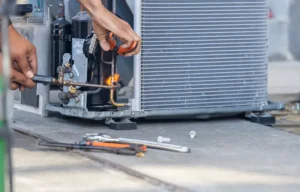
Every AC hums under load. But loud, aggressive buzzing is usually electrical in origin loose wiring, a failing capacitor, or a contactor that’s starting to arc. Debris inside the unit can cause it too. Wasps build nests in contactors more often than most homeowners realize, and that creates some genuinely confusing loud noises until you open the panel and see what’s in there.
Rattling
Rattling has the widest range of causes. Sometimes it’s a loose access panel or a screw that’s vibrated free, an easy fix. Other times, it’s a component that’s working itself loose, and rattling today becomes a much worse sound in a week. The issue with rattling is that it’s easy to dismiss, and that’s usually how small problems get time to become expensive ones.
Why Loud Noises Tend to Snowball
Here’s the pattern that plays out constantly in AC repair: something minor shifts, creates a little vibration or friction, and the homeowner notices but waits. The system still cools, so it feels fine. But that initial imbalance is adding wear every time the unit runs.
By the time “it’s been making that sound for a few weeks” turns into a service call, the original issue has often damaged something adjacent. A fan motor that started squealing and was left running can seize up and take out the compressor. That’s the difference between a few hundred dollars and a few thousand.
Loud noises aren’t the AC being dramatic. They’re mechanical feedback that something has changed.
When to Turn It Off Immediately
Some sounds leave room for interpretation. These don’t:
* Banging or clanking
* Grinding
* Screeching that doesn’t let up
* Any sound that feels violent or sharp
If you’re hearing any of those, shut the system down. Running it longer turns a repair into a replacement. That’s not an exaggeration, it’s just how mechanical failure progresses when you keep adding load to a damaged component.
Maintenance Catches This Earlier Than You’d Think
A lot of loud noises that show up in summer didn’t appear out of nowhere they built up over time. Worn bearings, loose electrical connections, aging capacitors. These things have warning signs that a trained eye catches during a routine service visit before they become audible problems.
Cleaning coils, checking motor performance, tightening connections it’s not complicated work, but it’s the kind of thing that keeps a system running quietly for years. Skipping maintenance doesn’t save money. It just pushes the cost forward with interest.
A Note on Older Units
Systems past the ten-year mark do tend to run a little louder as components wear. That’s expected. But there’s a real difference between “slightly louder than last season” and loud noises that are new, sharp, or inconsistent. If it’s crossed into genuinely noticeable territory, it’s worth a look. Older systems have less margin for error when something starts to go wrong.
FAQ
Can I run my AC for a few hours even though it’s making a loud noise?
It depends entirely on the sound. A mild rattle might be fine for a while. Anything banging, grinding, or screeching? No, the risk of cascading damage isn’t worth it.
Why does the noise sometimes go away on its own?
Temperature and load changes can temporarily quiet a problem, such as a bearing that stiffened up or a loose part that shifted. But if a loud noise appears, the underlying cause is still there.
Do loud noises ever come from inside the house?
Yes. The air handler and blower motor are inside, and they can produce squealing, rattling, or humming if something’s off. Don’t assume all AC sounds come from the outdoor unit.
Could a clogged filter actually cause loud noises?
Indirectly. Restricted airflow makes the blower motor work harder to try and cool the house, which accelerates wear and can increase operating noise over time. It’s not usually the first culprit, but it’s a contributing factor worth ruling out.
Should I try to investigate the unit myself?
Clearing obvious debris from around the outdoor unit is fine. Beyond that, these systems involve capacitors that hold a charge even when powered off, and moving parts that can cause injury. Diagnosing the source of a loud noise is a job for someone with the right tools and experience.
If your AC is suddenly louder than it used to be, trust that instinct. Most repairs caught early stay simple. The ones that get expensive are usually the ones that started with “I noticed something but figured I’d wait and see.”