
You set it to 74 on your way out the door. You get home at six and it reads 78. Nothing’s screaming, nothing’s dripping, and the air off the vents feels cold if you hold your hand up to it. It just never got there. That’s the call I take about forty times a summer, and Dallas heat is usually only half the story.
What’s Actually Wearing Out
House off Garland Road, twelve-year-old system, middle of July. Running roughly twenty hours a day. The homeowner wasn’t worried cold air was coming out, the bill was high but it was July, everybody’s bill is high in July. I told him it was working harder than it should be. He wanted to get through the season. Fair enough. Compressor let go the second week of September.
Long runs aren’t the problem by themselves. A right-sized system should run long stretches in July; that’s how the thing is designed. The problem is running long and still losing ground, because now the compressor’s shoving refrigerant against 101-degree air, trying to dump heat into a place that’s already full of it. That’s Dallas heat in one sentence.
It doesn’t usually kill a healthy system. It finishes off one that already had something wrong.
The Coil Nobody Looks At
Pull the top off a condenser around here in late June and you’ll find a felt mat of grass clippings and cottonwood fluff pressed into the fins. That coil’s got one job. Cover it, and it can’t do it, and blocked airflow drives head pressure up the same hole Dallas heat already has the system in.
Garden hose on low, spraying from the inside out, gets most of it. A pressure washer doesn’t. Flattened fins cost more than the dirt ever did.
The one that fools people is a coil that looks spotless from outside and is packed solid on the inner face. You’d have to pull the fan to see it, which is about where I’d rather you called somebody.
Why One Room Never Gets Cool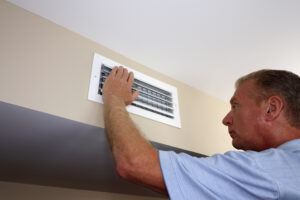
Most houses here run ductwork through the attic, and in August that attic sits around 140 degrees. Every crushed flex run and popped-loose boot up there is cooling insulation instead of your bedroom. In April you’d never catch it. Under Dallas heat, you catch it.
Change the filter first anyway. It’s five bucks and it’s the thing everybody skips one-inch pleated, two dogs in the house, that’s done in about thirty days no matter what the box says.
Woman in Richardson called me about a back bedroom that never got comfortable. Filter was gray, so we started there. Behind it, the return was undersized for equipment somebody had upsized years back. New filter helped a little. Didn’t fix the room.
Filters don’t fix ducts. Different AC problems, different repairs.
So How Long Should One Last Down Here?
Ten to fifteen years is what you’ll see quoted everywhere. In Dallas I’d plan on ten to twelve with maintenance and less without, because lifespan is a count of run hours, not birthdays. Dallas heat spins that meter faster than it spins anywhere north of the Red River.
Age alone still isn’t a verdict. A clean fourteen-year-old with no repair history beats an eleven-year-old on its third capacitor with a slow leak in the evaporator.
When it is time, that’s a licensed contractor and a permit. Texas licenses HVAC through TDLR and the city inspects the install. Anybody offering to skip that part is telling you how they’ll handle the rest of it.
Shop It Before You Need It
Nobody makes a good call on a new system in the last week of July booked four days out, house sitting at 85, taking whatever’s on the truck. Get eyes on it in spring and you’re comparing equipment instead of surrendering to it. We’re Not Comfortable Until You Are.
Questions We Get All Summer
Does the heat down here really wear a unit out faster?
It does, but it’s the hours doing it more than the temperature. A system here might log 2,000 run hours in a season where one in Ohio logs 700. Dallas heat doesn’t break parts. It keeps them working three times as long.
How often does it actually need servicing?
Once a year, and spring beats fall. Twice if it’s a heat pump, since that one works both seasons. If your outdoor unit sits under a live oak or backs up to an open field, get the coil looked at more often.
It’s still blowing cold, so I’m fine, right?
Not always. Cooling and cooling efficiently are two different things. If it’s running noticeably longer this summer to hold the same number it held last summer, something changed. Runtime tells you before warm air does.
Should I replace it just because it hit eleven?
No. Look at what you’ve spent on it lately. Two big repairs in eighteen months points one direction. One capacitor points nowhere.
What can I do myself in a heat wave?
Change the filter, clear a couple feet around the outdoor unit, close the west-facing blinds by early afternoon. Don’t drop the thermostat to 65 hoping to hurry it in real Dallas heat that just means it runs longer, not colder.
If it’s working harder this year than it did last year, don’t wait for it to quit on you in August.